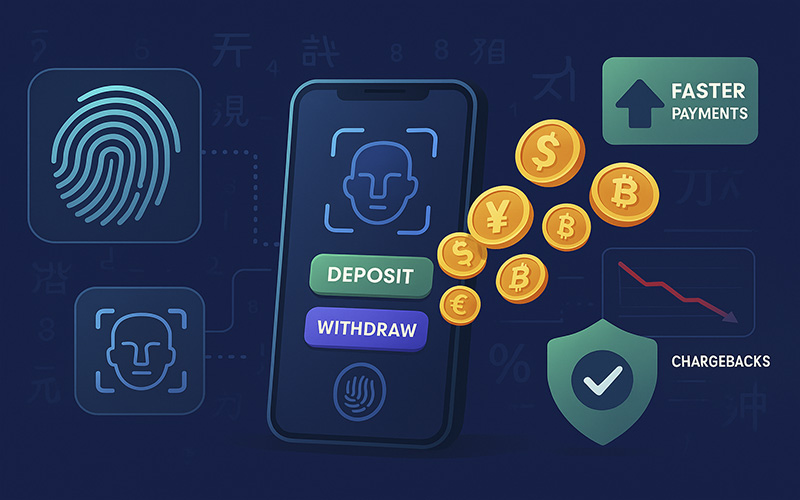
A well-configured and stable payment infrastructure is the foundation of a successful online casino project. Its reliability determines the platform's competitiveness, conversion rates, and audience retention.
According to Davide Villa, a financial advisor at Edgar, Dunn and Company, the total amount of completed wagers on entertainment portals has exceeded $4.2 trillion, while the global market revenue has reached $347 billion.
Bett-Market experts have prepared a detailed report on the technical structure of payment systems in the gambling industry and promising development directions for this segment. To get professional advice or order a turnkey business, please contact our managers.
Entertainment for money is traditionally considered a volatile business segment. For this reason, banks and alternative financial providers operate very discreetly in this area.
This situation has developed for several reasons:
Ambiguous legal status and strong regulatory framework. The greatest difficulties arise for platforms registered in offshore jurisdictions such as Curacao or Anjouan. Despite formal compliance with local standards, online casinos and bookmakers automatically fall into the shadow economy zone, where there is a great likelihood of blocking and fines.
High chargeback rate. Challenging betting transactions are a common phenomenon, which significantly worsens not only the brand’s financial performance but also its reputation. Moreover, the share of refunds due to ignorance of the rules is almost comparable to the number of intentional disputes that take place after losses.
Significant level of fraud. iGaming platforms are often used for placing bids via stolen cards, money laundering, or conducting sessions with forged documents. This is largely due to the lack of modern regulation and uniform standards in some regions. For this reason, the industry is still considered one of the riskiest for long-term investment.
Online gambling is often subject to regulatory restrictions and blocking in certain regions, so entrepreneurs must adapt the chain of financial procedures and add additional layers for transaction processing.
Let us look at the basic fund movement scheme from a bank card to an online casino’s or bookmaker's account:
Gateway. It does not participate in the transfer itself, but merely generates the request, encrypts the data, and transmits it to the processing centre.
PSP core. The key node through which routing and interactions between all parties occur.
Payment system. The brand responsible for authorising transactions. In the case of bank cards, this is most often Visa or Mastercard.
Issuer. The user's bank. It verifies the accuracy of personal details, as well as the availability of funds, and assesses the risk level.
Acquirer. The operator's financial institution that receives the transfer and credits money to the client's account within the entertainment platform. In certain situations, the chain can be even more extensive. For example, if anti-fraud services, local aggregators, intermediaries, etc., are integrated into the system.
The first concept describes a chain of providers that sequentially connect in the event of a failure or rejection of a transaction by the previous link. The mechanism automatically redirects the transfer, maintaining high conversion rates and reducing the number of unsuccessful attempts.
Routing is the distribution of payments between different channels.
It can be:
static, where paths for transactions of different sizes or types are predetermined;
dynamic (a customised route is generated for each request based on the current load, risk level, and other filters).
These are multifunctional services that provide an additional level of protection against offences.
Typical capabilities of such algorithms include:
detection of suspicious operations based on predefined criteria;
blocking attempts to place bets with stolen cards;
rejection of transfers processed using forged or incorrect documents;
reduction in the number of disputes and refunds.
Anti-fraud modules can be integrated into the gateways of fintech providers, as well as banking and entertainment platforms, or used as autonomous systems for independent monitoring.
If the main channel is temporarily unavailable or falls under regulatory restrictions, transfers are automatically routed through an alternative supplier. Such an approach significantly reduces the risks of failure and increases the stability of the entire digital platform.
This is especially relevant in countries where legal requirements are getting stricter and security measures are systematically intensified.
The modern solution is designed for projects launched in multiple jurisdictions or offshore zones. Efficient exchange algorithms help reduce costs on commissions and mitigate the impact of rate fluctuations.
Such modules can be integrated into gateways or ordered as a separate service from a financial provider.
These are operations with traditional currencies issued by national central banks.
To place bets, online casino visitors can use:
Bank cards. Customers simply enter the specified information and go through the appropriate authentication and payment confirmation procedures. This is the fastest and most convenient way, but in the iGaming segment, we can see a greater percentage of rejected transfers due to various banking filters.
Direct operations from a personal account. SWIFT and A2A (account-to-account) algorithms are used more often. This is a rather popular option for large transactions. The procedure guarantees a reduced risk of chargebacks, but is rarely applied due to the long request processing (up to several days).
E-wallets. This category includes Skrill, Neteller, and similar services. Players must replenish their accounts in the system and then use it to place bets. The advantages of this approach are instant credits and a more favourable attitude toward the online gambling niche. Disadvantages include mandatory fees, losses during the conversion, restrictions on international transfers, possible sanctions, and blocking.
Mobile payments. The remote intermediaries that provide authorisation are Apple Pay, Google Pay, and Samsung Pay. Due to the growing number of smartphone holders, this method is increasingly gaining fans. The option has become especially popular among the younger generation of players.
P2P transactions. The Person-to-Person scheme involves transfers between individuals. People send money not directly to the bank, but to another participant, who makes the final transfer and charges a commission. This approach is widespread in jurisdictions where blocking and limits on one-time deposits are quite common.
Broker-resellers. The format is similar to the P2P option, but the money is sent not to an individual, but to an officially registered agent, who sends an equivalent amount to the specified account. Such algorithms are most often used in emerging markets.
Payments in alternative digital assets are becoming increasingly popular and widespread. A study by Yield Sec reported that gross gaming revenue (GGR) from cryptocurrency bets reached $81.4 billion by the end of 2024. This represents a fivefold increase compared to 2022.
Statista experts reached similar conclusions. A global review of blockchain market trends noted that 10% of the global adult population already uses such payments in everyday life, including for wagering. By 2028, this figure will grow by 12.5%.
Reasons for the mass demand for decentralised offerings include:
no or minimal fees;
instant credits regardless of the time, frequency, or volume of transactions;
worldline availability;
elimination of the risk of chargebacks thanks to the structure of blockchain systems.
To accept bets and pay out winnings, 2 main methods are used:
direct operations without intermediaries (a fast and convenient solution for small transfers in one currency);
crypto gateways (automated asset processing and conversion services based on the needs of transaction participants).
The iGaming market has successfully overcome the side effect of digital coins’ high volatility. Many payments are now being made in stablecoins.
According to the BVNK fintech platform, these settlements account for half of all blockchain activity. Over the past 12 months, the total volume of such transfers has exceeded $2.5 trillion.
As the core components of the monetary architecture improve, casino developers are actively seeking new channels and data processing options that will become even more convenient and secure for players.
The most successful and promising solutions of the year include:
This is a comprehensive programming block for unifying a large number of different PSP channels and centralising their management through a dashboard.
The advantages of the tool include:
accelerated entry into new markets;
increased approval of transactions by up to 7% due to in-depth analytics and a scalable operational process;
automatic routing of settlements;
simplified integration of local aggregators.
According to a Dataintelo study, the payment orchestration segment in gambling reached $1.42 billion by the end of 2024. By 2033, this volume will grow to $5.13 billion with a CAGR of 15.8%.
They allow casino visitors to replenish their accounts and receive winnings in just a few minutes.
This is critical for entertainment portals, as any delay leads to a significant decrease in conversion. According to the Baymard Institute, the average payment interruption rate will reach 70.22% by the end of 2025. Basically, this is every third transaction.
Instant transactions have several benefits:
a more convenient user experience and increased consumer confidence;
Generative algorithms have found widespread application in the financial sector. A ZipDo report states that even at their current level of development, AI agents are capable of detecting approximately 63% of fraudulent activity.
Key capabilities of such systems include:
Powerful real-time protection. Algorithms analyse large data sets and promptly identify suspicious behaviour.
Reduction in the number of unjustified refusals. Systems more accurately recognise the purpose of transactions and block legitimate operations less frequently.
Early detection of risky actions. The technology helps identify users with potentially problematic interactions at the initial stage.
Personalisation of the interface and service processes. Artificial intelligence adapts UX elements and supports scenarios for individual characteristics of players.
Automation of key procedures. Conversion of funds, compliance checks, and other routine tasks are accelerated.
According to The Business Research Company, the total turnover of this market will exceed $46.38 billion by early 2026. In 2030, it can reach $66.97 billion.
The most common biometric verification method for the gambling vertical is login via fingerprint scanning or facial recognition. This mechanism can be used as an addition or a full-fledged alternative to two-factor authentication with passwords and one-time SMS codes.
Benefits of the approach include:
accelerated deposits and withdrawals;
enhanced fraud protection;
reduced risk of chargebacks;
simplified UX without the need to remember passwords or wait for verification codes;
increased trust in the gaming site.
The Business Research Company experts believe that in the next 2 years, biometrics will become the new standard for premium casinos and crypto platforms in the largest European markets and such developing regions as Latin America and Asia.
A financial gateway on a platform with slot machines is more than just a mechanism for account replenishment. It is a strategic node, the quality of which directly affects the conversion rate, sustainability of incomes, and business reputation of operators.
Key aspects that casino owners should consider:
There are no universal solutions — each jurisdiction requires different tools. These may include traditional bank transfers, e-wallets, local aggregators, or cryptocurrency services. Proper adaptation to regional specifics increases competitiveness.
The industry is focused on process optimisation. Cascade systems, routing, and automated redirection of payments increase the number of successful transactions and help reduce operating costs.
Security remains a key element of the long-term strategy. The implementation of biometric tools, AI-based anti-fraud solutions, and branded interfaces eliminates the risks of fraud, chargebacks, and technical failures.
For detailed analyses of the most important processes and practical recommendations on the launch and promotion of a profitable business, you can turn to the Bett-Market studio.
We closely monitor industry changes and offer comprehensive tools for a good start. Our catalogue includes ready-made strategies for various jurisdictions, turnkey platforms, products for land-based casinos, demo versions of the systems, and much more.
Check the information used to contact us carefully. It is necessary for your safety.
Fraudsters can use contacts that look like ours to scam customers. Therefore, we ask you to enter only the addresses that are indicated on our official website.
Be careful! Our team is not responsible for the activities of persons using similar contact details.
Fields with the * symbol (including captcha and the user agreement) are required.
The data was sent successfully.
Thanks for your application. We will get in touch with you shortly.
Close
An error occurred
Failed to send the message. Refresh the page and try again.
Refresh the page
If the download does not start automatically, copy the link:
Bett-Market-Presentation
Copy link
Copied!
processing
Fields with the * symbol (including captcha and the user agreement) are required
Attention!
Check the information used to contact us carefully. It is necessary for your safety.
Fraudsters can use contacts that look like ours to scam customers. Therefore, we ask you to enter only the addresses that are indicated on our official website.
Be careful! Our team is not responsible for the activities of persons using similar contact details.
Ok!
The data was sent successfully.
Thanks for your application. We will get in touch with you shortly.
Close
An error occurred
Failed to send the message. Refresh the page and try again.
Refresh the page
processing
Enter your Telegram login
This is your Telegram username that starts with “@”.
Fields with the * symbol (including captcha and the User Agreement) are required
If the application does not automatically open, use direct link to our channel.
Share with others
Payments on Gaming Platforms | Connect Reliable Software